
Publications with over 100 citations (derived from Google Scholar), 2024
1. Adverse events in New Zealand public hospitals I: occurrence and impact (2002)
Peter Davis, Roy Lay-Yee, Robin Briant, Wasan Ali, Alastair Scott, Stephan Schug
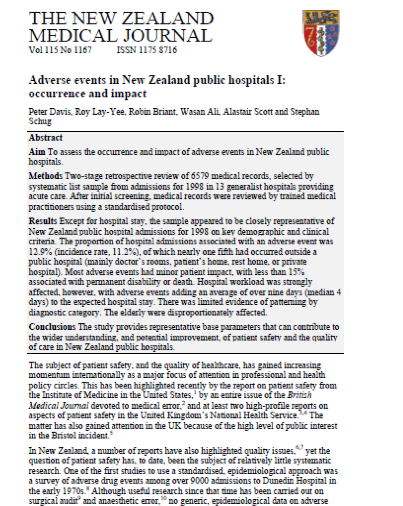
This study aims to assess the occurrence and impact of adverse events in New Zealand public hospitals. Methods Two-stage retrospective review of 6579 medical records, selected by systematic list sample from admissions for 1998 in 13 generalist hospitals providing acute care. After initial screening, medical records were reviewed by trained medical practitioners using a standardised protocol.
2. Translating research findings into health policy (1996)
Peter Davis, Philippa Howden-Chapman
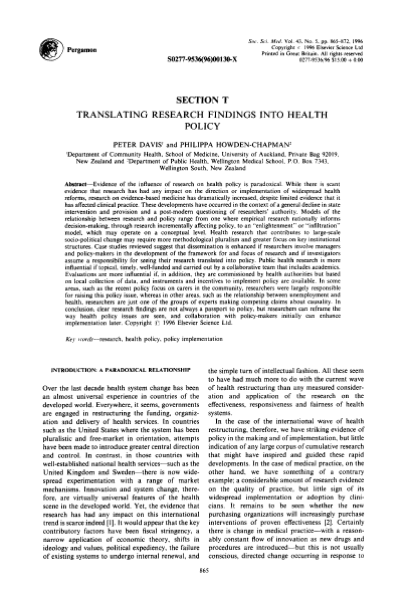
Evidence of the influence of research on health policy is paradoxical. While there is scant evidence that research has had any impact on the direction or implementation of widespread health reforms, research on evidence-based medicine has dramatically increased, despite limited evidence that it has affected clinical practice.
3. Adverse events in New Zealand public hospitals II: preventability and clinical context (2003)
Peter Davis, Roy Lay-Yee, Robin Briant, Wasan Ali, Alastair Scott, Stephan Schug

Methods: two-stage retrospective review of 6579 medical records randomly sampled from admissions for 1998 in 13 generalist hospitals providing acute care. Initial screening and medical review according to a standardised protocol. Results Eight hundred and fifty adverse events were identified, of which over one third (315) were preventable to a significant degree. Preventability of events increased with age of patient, and was more characteristic of certain diagnostic categories.
4. Adverse events in New Zealand public hospitals: principal findings from a national survey (2001)
Peter Davis, Roy Lay-Yee, Robin Briant, Stephan Schug, Alastair Scott, S Johnson, W Bingley
A two-stage retrospective review was carried out on 6,579 medical records. These were selected by systematic list sample from admissions for 1998 occurring in 13 public hospitals throughout New Zealand providing acute care and with over 100 beds, excluding specialist institutions. Following initial screening, medical records were subject to structured implicit review (that is, the guided exercise of professional judgement) by a team of trained medical officers using a standardised protocol.
5. The sociology of pharmaceuticals: progress and prospects (2008)
Simon J Williams, Jonathan Gabe, Peter Davis

This paper takes a critical look at progress and prospects regarding the sociology of pharmaceuticals over the years. Key themes examined include: (i) medicalisation and pharmaceuticalisation; (ii) regulation; (iii) consumption and consumerism; (iv) expectations and innovation. Papers in the monograph are also introduced and discussed in relation to these themes.
6. The New Zealand Socioeconomic Index of Occupational Status (NZSEI), 1997
Peter Davis, Keith McLeod, Miriam Ransom, Patrick Ongley

This publication discusses the construction and validation of the New Zealand Socioeconomic Index (NZSEI), an occupationally derived indicator of socioeconomic status.
7. Relationship between complaints and quality of care in New Zealand: a descriptive analysis of complaints and non-complaints following adverse events (2006)
MM Bismark, TA Brennan, RJ Paterson, PB Davis, DM Studdert

The article aims to estimate the proportion and characteristics of patients injured by medical care in New Zealand public hospitals who complain to an independent health ombudsman, the Health and Disability Commissioner (“the Commissioner”). The percentage of injured patients who lodge complaints was estimated by linking the Commissioner’s complaints database to records reviewed in the New Zealand Quality of Healthcare Study (NZQHS).
8. Adverse events regional feasibility study: indicative findings (2001)
Peter Davis, Roy Lay-Yee, Stephan Schug, Robin Briant, Alastair Scott, Sandra Johnson, Wendy Bingley
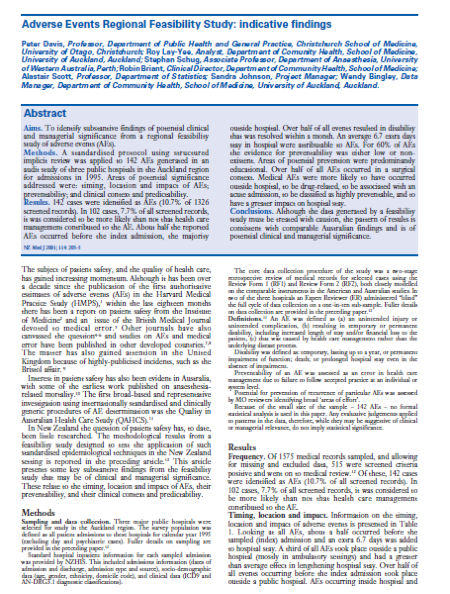
Aims: to identify substantive findings of potential clinical and managerial significance from a regional feasibility study of adverse events (AEs).Methods. A standardised protocol using structured implicit review was applied to 142 AEs generated in an audit study of three public hospitals in the Auckland region for admissions in 1995. Areas of potential significance addressed were: timing, location and impact of AEs; preventability; and clinical context and predictability.
9. Quality of hospital care for Māori patients in New Zealand: retrospective cross-sectional assessment (2006)
Peter Davis, Roy Lay-Yee, Lorna Dyall, Robin Briant, Andrew Sporle, Deborah Brunt, Alastair Scott

New Zealand has a substantial indigenous minority—the Māori—that has considerably worse health status than the majority population. We aimed to assess possible disparities in quality of hospital care for Māori with data on preventable adverse events as an indicator of suboptimum treatment.
Read more
10. Compression, expansion, or dynamic equilibrium? The evolution of health expectancy in New Zealand (2004)
Patrick Graham, Tony Blakely, Peter Davis, Andrew Sporle, Neil Pearce

The study aims to evaluate the New Zealand evidence for three theories of population health change: compression of morbidity, expansion of morbidity, and dynamic equilibrium. Using the Sullivan method, repeated cross sectional survey information on functional limitation prevalence was combined with population mortality data and census information on the utilisation of institutional care to produce health expectancy indices for 1981 and 1996.
11. Efficiency, effectiveness, equality (E3). Evaluating hospital performance in three dimensions (2013)
Peter Davis, Barry Milne, Karl Parker, Phile Hider, Roy Lay-Yee, Jackie Cumming, Patrick Graham

There are well-established frameworks for comparing the performance of health systems cross-nationally on multiple dimensions. A sub-set of such comprehensive schema is taken up by criteria specifically applied to health service delivery, including hospital performance.
We focus on evaluating hospital performance, using the New Zealand public hospital sector over the period 2001–2009 as a pragmatic and illustrative case study for cross-national application.
12. The “supply hypothesis” and medical practice variation in primary care: testing economic and clinical models of inter-practitioner variation (2000)
Peter Davis, Barry Gribben, Alastair Scott, Roy Lay-Yee

Medical practice variation (MPV) is marked, apparently ubiquitous across the health sector, well documented, and continues to be a focus of professional and policy interest. MPV have stimulated two paths of investigation, one economic in emphasis and the other more clinical in orientation; while health economists have stressed the potential role of income incentives in medical decision-making, health services research has tended to emphasise clinical ambiguity as a factor in practitioner decisions.
13. Preventable in-hospital medical injury under the “no fault” system in New Zealand (2003)
P Davis, R Lay-Yee, R Briant, A Scott
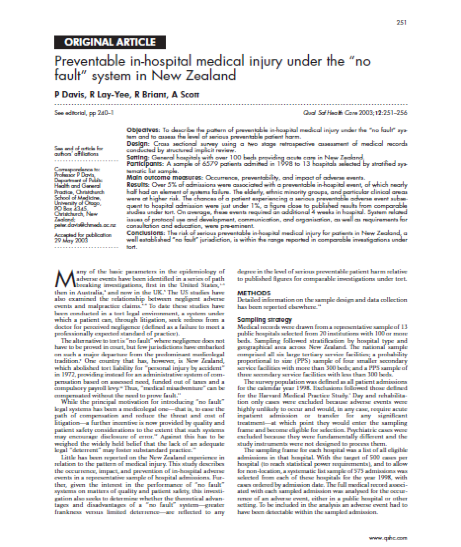
This article aims to describe the pattern of preventable in-hospital medical injury under the “no fault” system and to assess the level of serious preventable patient harm. It is a cross sectional survey using a two stage retrospective assessment of medical records conducted by structured implicit review. Setting: General hospitals with over 100 beds providing acute care in New Zealand.
14. How much variation in clinical activity is there between general practitioners? A multi-level analysis of decision-making in primary care
Peter Davis, Barry Gribben, Roy Lay-Yee, Alastair Scott
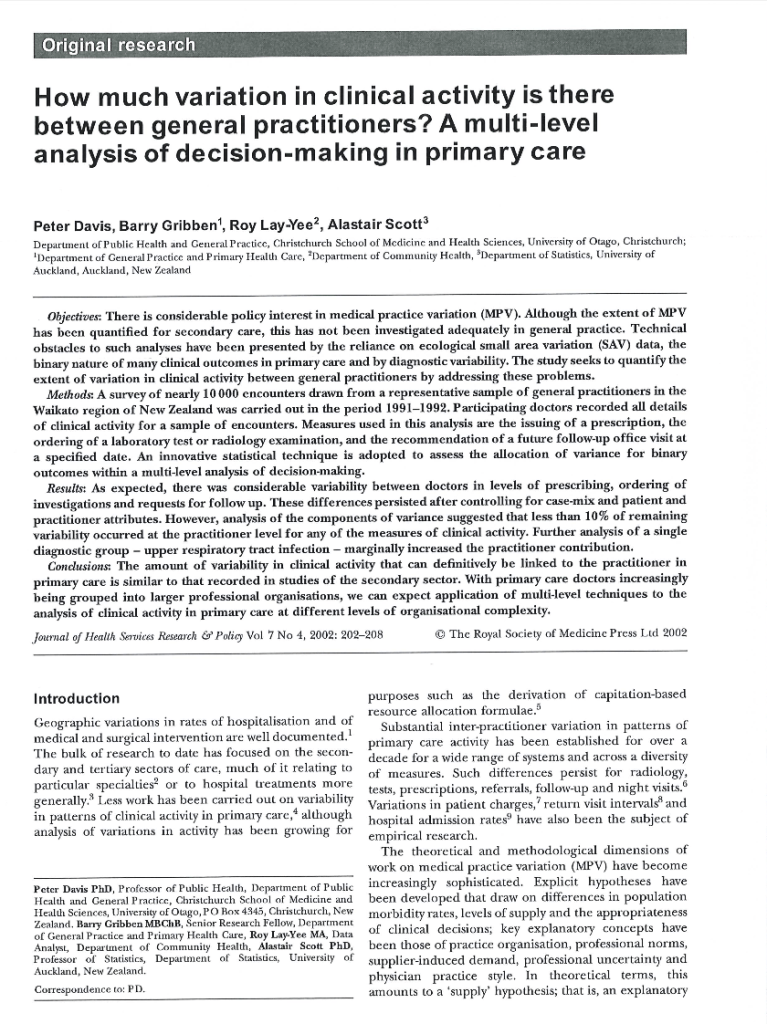
There is considerable policy interest in medical practice variation (MPV). Although the extent of MPV has been quantified for secondary care, this has not been investigated adequately in general practice. Technical obstacles to such analyses have been presented by the reliance on ecological small area variation (SAV) data, the binary nature of many clinical outcomes in primary care and by diagnostic variability. The study seeks to quantify the extent of variation in clinical activity between general practitioners by addressing these problems.
15. Association of environmental tobacco smoke exposure with socioeconomic status in a population of 7725 New Zealanders (1998)
Gary Whitlock, Stephen MacMahon, Stephen Vander Hoorn, Peter Davis, Rodney Jackson, Robyn Norton
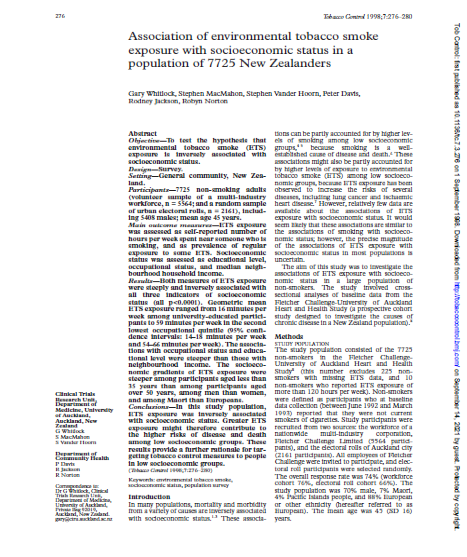
The objective of the survey is test the hypothesis that environmental tobacco smoke (ETS) exposure is inversely associated with socioeconomic status. 7725 non-smoking adults took part (volunteer sample of a multi-industry workforce, n = 5564; and a random sample of urban electoral rolls, n = 2161), including 5408 males; mean age 45 years.
16. Contested Ground: Public purpose and private interest in the regulation of prescription drugs
Peter Davis (Ed.), New York; Oxford: Oxford University Press
Available on Trove
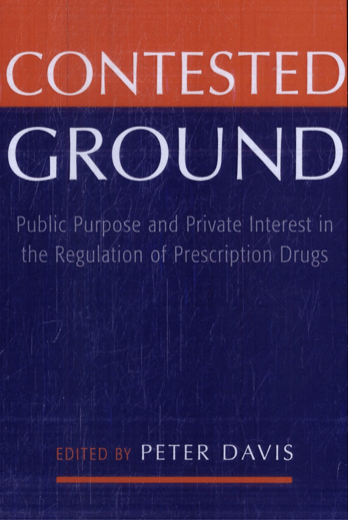
Addressing the key issues in the public debate about prescription drugs, this book establishes an analytical framework for the development of regulatory policy in this area. A range of international experts, working at the interface between the social sciences, pharmacy, medicine, and public policy debates, contribute to the delineation of these issues.
The underlying theme of the book is that therapeutic drugs should not be considered ordinary products. These drugs raise important social, ethical, and policy questions that transcend orthodox analytical approaches and that cut across conventional disciplinary boundaries. The object of this book, therefore, in not just to identify the major issues but also to develop some of the analytical foundations required to advance the course of public policy debate in this area.
 Peter Davis NZ