

Published in The Post, 30 January 2025
The 55th. Annual Meeting of the World Economic Forum (WEF) took place last week in Davos, a modest Swiss ski resort not far from Zurich. For all its apparent modesty, throughout the week this small mountain settlement welcomed close to 3,000 visitors from 130 countries, including 1,600 business leaders and 350 heads of state and government, ministers and senior government officials.
Under the rubric “Collaboration for the Intelligent Age” over 500 sessions involving the private, public, and community sectors were held across five themes: reimagining growth; industries in the intelligent age; investing in people; safeguarding the planet; and rebuilding trust.
All very worthy. But what does it achieve? Principally an enormous amount of information exchange, networking and deal-making on the major policy concerns of the day across private, public and community sectors, mainly at an elite level and mainly trans-Atlantic in focus, but increasingly with involvement from the “global south”.
Sixty-nine WEF reports were launched at Davos and a great range of existing and new initiatives on growth, productivity, industry net zero, women’s health, future councils, digital healthcare, navigating climate risk, shift to a nature-positive future, and global cooperation, among many other cross-cutting and focused topics of public interest.
Yet, for all this activity building on a corpus of existing and long-standing work, this year’s meeting did not feel like “business as usual”. On the penultimate day Donald Trump was beamed in to a packed congress hall with a message of tax cuts, deregulation, rolling back climate change initiatives, sidelining ESG (environment, social, governance) and DEI (diversity, equity, inclusion) considerations, and prioritising “America first” over traditional alliances and the constraints of multilateralism.
Donald Trump’s address was applauded to the rafters.
In other words, for all the worthy initiatives on the social responsibility of corporates, on anticipating the greatest planetary threat of our time, and on a range of existential threats in the environment, misinformation, and social and political conflict, in the end it is the immediacy of tax cuts, deregulation and pausing climate change initiatives that seems to sway the emotions of the global corporate class.
An apparent inflection point in global affairs, then, and at some distance from New Zealand geographically and politically. But were there any pointers for our political and corporate class?
Energy primacy and security. While the use by Russia of its gas supply as a political weapon may have brought the issue to a head, there was general agreement that the security, quality, and cost of energy lies at the heart of functioning economies. It is striking that in New Zealand we have not had explicit recognition of this, with no obvious forward-looking energy policy and a gaping susceptibility to supply-chain and production vulnerabilities.
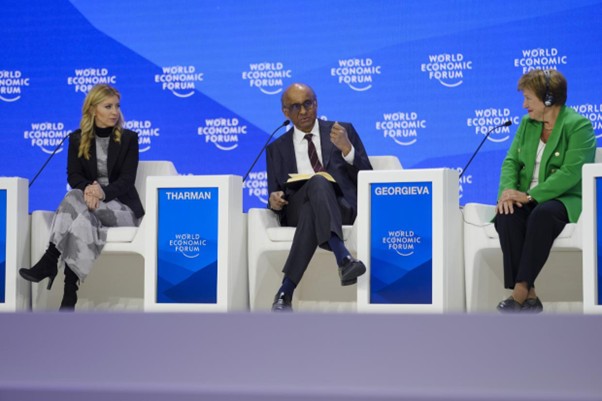
Energy transition. Klaus Schwab, in his opening address, pitched the conference as marking a transition from the industrial to the intelligence age. With that goes a fundamental energy transition. While coal, oil and gas fuelled the industrial revolution, “clean energy” is the driving force of an age focused on artificial intelligence, digital enablement, the limits of traditional growth metrics, and the appreciation of planetary boundaries. Arguably New Zealand has squandered its opportunities. Take Norway another country initially reliant on hydropower. It is now on the brink of renewable dominance, while New Zealand flounders.
Global economy. While the meeting of Chief Economists was downbeat, the leader of the WTO pointed out that 80% of world trade is conducted according to WTO rules and, rather than deglobalisation, what we are likely seeing is a form reglobalisation with new supply chains and localised production hubs. There are no magic solutions to growth, other than innovation, smart regulation, competitiveness, productivity, and investment.
Small economies. Are there any “big ideas” for small economies like ours? Singapore featured here. The key lessons seemed to be that the country had to make its own luck, has been pragmatic, consistently governed, has enforced savings alongside tax, has developed a tripartite, consensual approach, and uses industry sectors and clusters. New Zealand by contrast was once one of the wealthiest countries in the world, but it has allowed complacency and short-termism to squander that advantage. Can one imagine Singapore taking half a century before it successfully encouraged savings for retirement and sovereign wealth, or allowing an industrial champion like Fonterra to sell its key brands to an overseas bidder?
Misinformation. Along with environmental threats and conflict, this was one of the key risks identified by CEOs surveyed by WEF. With the decline of mainstream media and the rise of social media echo chambers, New Zealand needs to take stock of its options in this area. We have a vanishingly small public broadcaster, our major media outlets are losing staff and closing outlets, the social media giants are not paying their way, and since the Christchurch Mosque massacre, we still have not found a way to sensibly moderate the public square.
Davos is rightly criticised as being overly elitest and too cosy a club of the traditional transatlantic alliance. But for anyone prepared to stand back and survey the proceedings, there are still nuggets of insight that even a small, distant country like New Zealand can learn from.
Peter Davis, Emeritus Professor in Population Health and Social Science, University of Auckland
If you want to subscribe to my posts, go to https://peterdavisnz.com/ and follow the instructions. You will be joining quite a few others!
Discover more from Peter Davis NZ
Subscribe to get the latest posts sent to your email.
 Peter Davis NZ
“There are no magic solutions to growth, other than innovation, smart regulation, competitiveness, productivity, and investment.”
I feel this is critical for a small economy nation such as New Zealand . For many years New Zealand would compete with Singapore as the most innovative and competitive countries globally but in recent years this investment into New Zealand as a dynamic innovation hub and ecosystem has waned and it would be great to recapture this space. As agendas such as food systems transition, investing in nature, climate adaptation, trust in more open digital and data systems driving traceability and transparency there is a definite economic pathway in creating a more agile and innovative economic investment models.
Interestingly, the WEF Global risk report highlighted that though misinformation/disinformation remain critical short-term risks for the second consecutive year, environmental risks dominate the longer-term outlook, with extreme weather events, biodiversity loss and ecosystem collapse, critical change to Earth natural resources balance continuing to lead the 10-year risk rankings. Addressing this provides opportunity for leadership and agile new economic models to emerge. As you say, however, this will require a focus on smart policy, innovative investment and the building out of a dynamic innovation ecosystem to turn this around from risk to targeted opportunity space for the New Zealand economy. Singapore and countries like it have appreciated this need for the continued nurturing of an innovation economy and the associated skills building that goes with it. I just hope New Zealand can refind its own brand of dynamic economic leadership in positioning itself as a dynamic and agile innovation powerhouse.
LikeLike
Sean. Thanks for your constructive engagement on this issue. You know both the New Zealand context and, through your work at WEF, the global trends. Very useful. Yes, we are all looking for something along the lines sketched in your two final sentences. Here’s hoping! peter
LikeLike
Aoetearoa New Zealand seems to have been run by shortsighted people for a very long time even in councils it seems to attract people who are only interested in the short term I don’t understand this kind of psych I’m amazed that we are still arguing about a comprehensive rail system in our country especially in cities like Auckland.
LikeLiked by 1 person
The electoral system has a lot to do with it. You cannot argue for increasing rates or taxes and get elected, but you can by arguing for tax cuts and deferring essential work.
LikeLike
Thanks Peter. I could observe that your insomnia seems to still be active……….
Garry
LikeLike
Haha. I am in the UK for a week, post-Davos. Coming back to NZ soon for a bit of rest and recreation!
LikeLike
Two basic problems. 1. There is no infinite growth on a finite planet. Our obsession with growth needs to stop yesterday. 2. Economies are fundamentally driven by power, not innovation, smart regulation, competitiveness, productivity, and investment. If this isn’t recognised, all thoughts about economic success are magic thinking.
Corollary, in a time of decline power availability, which is what will happen if we transition out of fossil fuels with their dense energy, economies will shrink.
LikeLike
It’s a hard sell!
LikeLike