
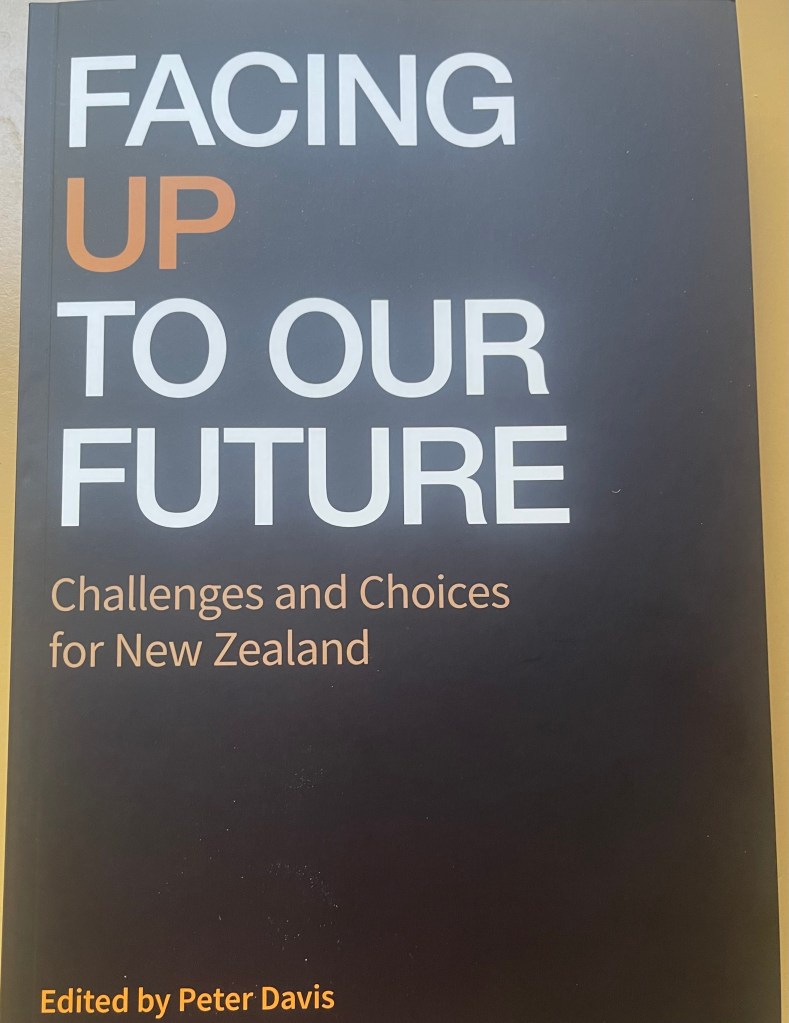
Introduction. Facing Up to Our Future (The Helen Clark Foundation and AUT University. Dunmore Press)
Introduction
New Zealand has been through tough times over the last 15-20 years: Global Financial Crisis, Christchurch and Kaikoura earthquakes, Christchurch Mosque mass shootings, Whakaari/White Island eruption, Covid 19, multiple cyclones and storms, the fracturing of the political landscape consequent on greater polarisation, and now an extended downturn with low growth, high migration and unemployment further amplified by the war in the Middle East. At present there seems to be little prospect of early relief, and there is no obvious political consensus on the way ahead.
With the shrinking base of the major centrist parties, the polarisation of opinion, the amplification of these issues by mainstream and social media on a 24/7 cycle, with the hollowing out of the public service and the relative absence of universities from the public square, it is hard to see how long-term issues can be shaped and crystallised for implementation in an evidence-based, deliberative and consensual fashion.
Stating the Problem
In their book Policy-making Under Pressure, University of Canterbury academics Sonia Mazey and Jeremy Richardson note that New Zealand’s policy style is short-term, reactive, and lacking continuity, and argue for longer parliamentary terms, standing policy commissions, and enabling non-parliamentarians to serve as Ministers.
In other words, in New Zealand we have a problem in dealing with long-standing issues that grow over time, that have been clearly signalled, and that require timely intervention and the earmarking of resources.
Let’s take water infrastructure. The fundamental problem has been that, with few exceptions, local authorities just have not set aside the funding required to maintain, upgrade and future-proof their water infrastructure. And now they face major charges to catch up.
And then there’s Cyclone Gabrielle. Everyone agrees that the severity of the storm was very likely exacerbate by climate change. The basic problem here is that, despite legislative and other commitments on the issue, concrete action on adaptation has been weak.
And these are not the only such examples of our failure to address fundamental policy challenges. There are others.
New Zealand’s Quota Management System (QMS), first canvassed in 1986, sought to establish fishing quotas for the commercial industry. Yet, in a recent review of the sector by the former Chief Science Advisor to the Prime Minister, it was established that nine fish stocks have collapsed and another dozen or so are either overfished or at risk of overfishing. Furthermore, the sector is in many cases not collecting key information on the state of fish stocks, failing to record bycatch, and conducting destructive bottom trawling.
Here’s another example. The Treasury, in its regular Long-Term Fiscal Statement, has estimated that our current commitments and taxpayer funding trajectories for superannuation and health care will produce a revenue shortfall of 15% of GDP by 2061. There is at present no provision for meeting this shortfall. If these other major issues are anything to go by, in 30-40 years we will still be contemplating this issue without any clear way forward.
The policy problem is easily stated. It is possible to identify these four issues as being a failure to respond appropriately to what a recent report of the World Economic Forum calls “intergenerational foresight”. In every case “the can is being kicked down the road” because of current short-term, political constraints. Yet it is future generations that will have to bear the consequences – whether that be fronting up on the impacts of failing water infrastructure, dealing with the effects of global warming, repairing depleted fishing stocks and damaged ecosystems, or paying for unfunded liabilities on pensions and health care.
This is not a problem unique to New Zealand. In Australia the Grattan Institute, a bipartisan think tank, reviewed over 70 policy reports issued by the organisation in the decade from 2009, mostly mainstream OECD proposals, and found two-thirds had never been adopted. Where these proposals were publicly unpopular, none were taken up. Ideological party lines were also showstoppers. Other reforms were opposed by vested interests but could find political acceptance if the evidence in their favour was strong.
Contributing to a Solution
Can anything be done? Arguably, not much can be done under our current political regime of short-term political decision-making, policy flip-flops, and failure to plan for the long term.
This concern is what inspires this book: the need to look beyond the standard electoral cycle to longer-term solutions that might achieve buy-in across the political spectrum. Other countries have managed this, although these tend to be small, more cohesive, and less adversarial nations where compromise and long-term commitment are rewarded rather than punished. Denmark, Ireland, and the Netherlands could be examples of other small liberal democracies that have managed major transitions to get them through adverse circumstances and achieve long-term objectives in the economy, society, health, education, and housing.
One example that is closer to home is the role of non-partisan think tanks such as the Grattan Institute in Australia that produces what it calls the Orange Book in the run-up to the Federal election highlighting key issues that are not getting the attention they deserve in among the short-term politicking that can dominate “business as usual” in the political and policy process. The Helen Clark Foundation seeks to fulfil a similar role in New Zealand, hence the support for this book.
With this in mind, we have pulled together about 20 experts and commentators across disciplinary and institutional boundaries to work through the four sectors of the economy, society, governance, and the environment to address concrete problems of a long-term nature with practical solutions that could work overtime and across the political spectrum.
Each chapter is short – no more than 2,500 words – and provides a non-partisan “policy explainer” designed to inform the reader about an enduring policy problem, why it has been so hard to resolve, and what might be a practical way forward.
We have tried hard to make the book as readable and accessible as possible. Thus, each chapter is headed by half a dozen “take-home messages” to help the reader grasp its core argument, and we have restricted the listing of sources to half a dozen per chapter under the heading Further Reading.
In a concluding chapter I bring together a brief summary of the key themes through the book, along with contributions to the debate from sources elsewhere on the policy landscape.
As a footnote, it should be added that none of the chapters in this book has used AI tools to generate content. All are the product of the creative spirits and energies of our contributors. That said, in some instances we have relied on assistance from AI tools for purely editorial purposes to summarise information as a first approximation: the half dozen “take-home messages” for each chapter and checking references.
We hope you enjoy the read, and we look forward to continuing to inform New Zealand’s longer-term public policy direction now and in the future.
Further Reading
Grattan Institute (2018) Gridlock: Removing Barriers to Policy Reform. Melbourne: Grattan Institute.
Grattan Institute (2022) Orange Book 2022: Policy Priorities for the Federal Government. Melbourne: Grattan Institute.
Mazey, S. and Richardson, J. (2020) Policy-Making Under Pressure: The Challenge of Policy Reform in New Zealand. Cheltenham: Edward Elgar.
New Zealand Treasury (2025) He Tirohanga Mokopuna 2025: The Treasury’s Statement on the Long-term Fiscal Position. Wellington: The Treasury.
Office of the Prime Minister’s Chief Science Advisor (2022) The Future of Commercial Fishing in New Zealand. Wellington: Office of the Prime Minister’s Chief Science Advisor.
World Economic Forum (2024) Fostering Intergenerational Foresight: Policy Pathways for Long-Term Governance. Geneva: World Economic Forum.
Peter Davis, Emeritus Professor in Population Health and Social Science, University of Auckland
If you want to subscribe to my posts, go to https://peterdavisnz.com/ and follow the instructions. You will be joining quite a few others!
Discover more from Peter Davis NZ
Subscribe to get the latest posts sent to your email.

