
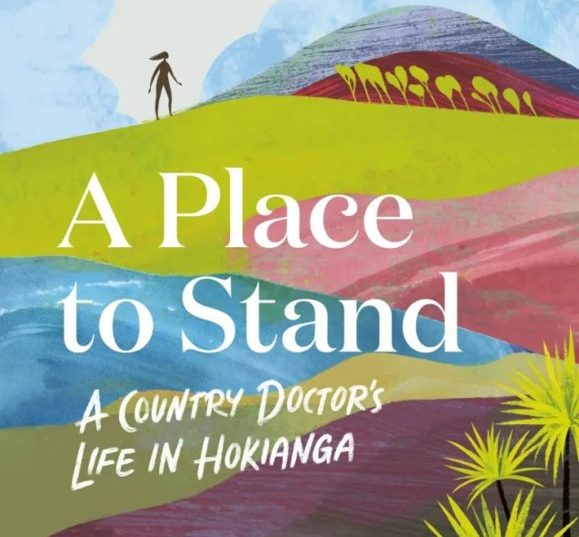
Book Review – “The makings of a New Zealand classic”. (newsroom, 27 July 2026)*
Clare Ward’s memoir A Place To Stand has the makings of a New Zealand classic. She came to the Hokianga 30 years ago as a Pākehā GP and a town dweller. She writes that becoming part of the Hokianga involved a rearrangement of her values. Her ancestors came from Ireland and England. For her The Treaty of Waitangi gave her a place to stand, hence the book’s title. There’s poetry, scriptural homilies, Māori sayings, evocative illustrations all interspersing a carefully curated collage of the author’s reflections and impressions. It’s a multi-dimensional story, as well as a rich and textured ethnography.
It depicts a time capsule, a capsule of geography, community, culture, and the meeting of different worlds. But it is a capsule of time that has largely passed. There are no drugs in her book, and, aside from one incident, no crime, no guns, and little violence. There are elderly Māori speaking te reo, and some who cannot speak English. There are rough and sometimes impassable roads, dwellings on the brink of collapse, volunteers working essential services at inconvenient times. But it is a capsule worth preserving.
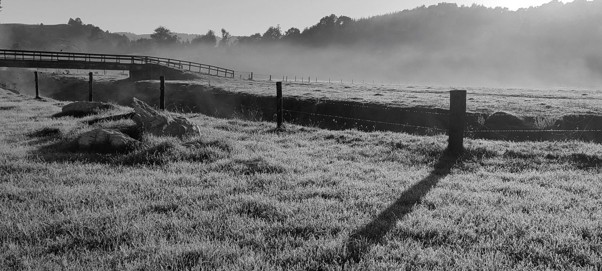
The book opens with three double-page spreads of photos from the Hokianga—stills in black and white. But just picture them as moving visuals of colour and place. You are prompted to imagine and visualise the geography, the wildlife, the nature of this special region. There is a dedication to the author in the foreword: “How proud your people, your iwi, are of you and your service. We have named you Kahurangi rata Clare Ward. A rata who serves her Hokianga people: no matter where they stay, no matter their need, no matter the time, no matter the call. Hone Taimona”. Imagine the community sentiment and respect that lies behind this statement. You may shed a tear or two as you come to appreciate the community embrace and cultural overlay on your way through the book.
A Place To Stand offers an insight into the beating heart of health care—general practice, also known as family practice. What makes the news and the headlines is the drama of specialist medicine, and rightly so in many respects. But as Ward writes, “There is a substance to general practice which goes beyond the physical realities of heart and lungs and brains, to encompass what it is that makes a person feel well and complete”. The beating heart of health care throbs throughout this book, with a special resonance given the unique circumstances of the Hokianga.
There are no numbered chapters in this book. Headings capture the essence of a series of reflections. ‘Doorways’ refers to a place between two spaces, including the relationship between doctor and patient. In the section with the heading ‘At the end of the day’, the author explores one area where certain cultural values have made a difference to medical practice – pathology and post-mortems. A family did not want the body of their son cut up to investigate a cause of death. At the time post-mortems were almost routine. Nowadays a family’s wishes might be more closely attended to by medical practitioners.
When Clare Ward first went to a particular clinic in the 1980s, all the older Māori spoke te reo. On one visit there was a collection of older Māori women tending to a baby. The baby went to Whangārei Hospital for a week and survived. It had whooping cough. One of those kuia said to her, “When you return to Hokianga you must learn Māori”. The author did not know she would be returning since she was just on a temporary locum placement in the Hokianga. But return she did. Now when she revisits that same clinic, she sees the children of that Kuia. She refers to that early experience 40 years ago: “The baby stayed awake. I started to see and understand more. The baby lived. The seed inside me grew into a tree.”
There are plenty of patient stories here, some routine, others almost hair-raising. But at the base, this book is about a meeting of two worlds, and in a setting that might be hard to reproduce now. It is appropriately laced with allusions to nature, geography, emotions, poetry, and spirituality in both religious and Māori worlds.
Clare Ward was a student in my first-year medical sociology class back in the late 1970s. Over the several years I taught that class she is almost the only student in an annual class of 100 I can remember in person and by name. I never stayed in touch, and it is only the arrival of this book that brought that memory back to me.
At the back of that class typically sat the Pākehā boys from Auckland Grammar and King’s School wondering what these lectures were all about. At the front sat those who were earnest and keen, older students, some non-Pākehā, and young women. Clare stood out as someone with maturity and leadership. I now realise she was a mature student with a PhD in Zoology, only two years younger than I was at the time. What a gift those mature students were. They brought life experience and reflective vocational commitment that leavened the school-leaver class.
And, if this book is any indication, they can give back to the community in ways that are not dictated by a narrow vocational view of their profession, but a broader perspective informed by personal values and life experience. We are fortunate that this gift is captured in A Place To Stand.
A Place to Stand: A country doctor’s life in Hokianga by Clare Ward (Allen & Unwin, $37) is available in bookstores nationwide.
*This review was expertly edited by the Newsroom Book Review editor, Steve Braunias.
Peter Davis, Emeritus Professor in Population Health and Social Science, University of Auckland.
If you want to subscribe to my posts, go to https://peterdavisnz.com/ and follow the instructions. You will be joining quite a few others!
Discover more from Peter Davis NZ
Subscribe to get the latest posts sent to your email.


Fabulous book review Peter. A must read for us to better understand this place in the world that we inhabit for such a short time. Just reading your review brought a lump to my throat on some of the stories you share.
LikeLike
Thank you. Well, that’s how I felt at times while I was reading the book. Steve Braunias did a great job editing my original review so that it flowed better and lost some of the extraneous details I had in there. All the best, peter
LikeLike